


AI Cooling Showcase | San Diego, CA | scaleMatrix
See AI Cooling
In Action
DDC Solutions and Chilldyne have built a fully operational hybrid cooling environment inside a production data center, running real customer GPU workloads every day. Come see exactly what protects your infrastructure before you commit.
Visits include facility walkthrough, live architecture briefing, and onsite training. Available to qualified customers and partners.




NOT A DEMO ENVIRONMENT
“This isn’t a showcase of what’s possible. It’s a showcase of what’s running.”
Most cooling demonstrations operate on controlled loads in staged conditions. The DDC and Chilldyne Showcase at ScaleMatrix runs live, commercial GPU workloads operated by Cirrascale — one of the leading GPU-as-a-service providers in the country. The infrastructure is not configured for the visit. It is running before you arrive, and it will be running after you leave.
When you walk the floor, you’re seeing real thermal load, real cooling response, and real asset protection in action.
EXPERIENCE OVERVIEW
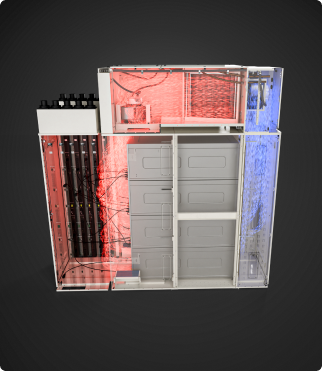
Modern AI GPU clusters generate more heat than any single cooling technology can manage. DDC’s S-Series Rack Containment Unit handles the airside load, isolating and managing residual heat at the cabinet level in real time. Chilldyne’s patented CDU technology handles direct-to-chip liquid cooling at the chip level. Together, the architecture delivers up to 380 kW per cabinet. You’ll see both systems operating simultaneously, under load.
Modern AI GPU clusters generate more heat than any single cooling technology can manage. DDC’s S-Series Rack Containment Unit handles the airside load, isolating and managing residual heat at the cabinet level in real time. Chilldyne’s patented CDU technology handles direct-to-chip liquid cooling at the chip level. Together, the architecture delivers up to 380 kW per cabinet. You’ll see both systems operating simultaneously, under load.
Modern AI GPU clusters generate more heat than any single cooling technology can manage. DDC’s S-Series Rack Containment Unit handles the airside load, isolating and managing residual heat at the cabinet level in real time. Chilldyne’s patented CDU technology handles direct-to-chip liquid cooling at the chip level. Together, the architecture delivers up to 380 kW per cabinet. You’ll see both systems operating simultaneously, under load.
Inside the showcase:
the technology in action
Every element of the DDC and Chilldyne hybrid cooling architecture is visible, labeled, and running under live load when you visit. Here’s what you’ll see — and why each component matters to your deployment.
DDC S-Series rack containment unit

NEMA 3R-rated enclosure
Sealed physical containment at the rack level. Protects GPU hardware from contamination, fluid events, and unauthorized access. Required for compliance in regulated deployment environments.

Integrated rack-level fire suppression
Detects and suppresses thermal events before they propagate to adjacent equipment. Operates independently of room-level suppression systems, minimizing blast radius and hardware loss.


Dynamic airside cooling
Manages the residual thermal load not captured by direct-to-chip liquid cooling. Airflow adjusts automatically in real time as workload density changes across the rack.

DCIM monitoring panel
Per-rack visibility: thermal data, airflow performance, alarm status, and system health — all in real time from the integrated DCIM dashboard.
Chilldyne CDU technology

Negative-pressure CDU architecture
Patented design that inverts the conventional liquid cooling failure mode. Any seal failure draws air inward rather than forcing coolant onto GPU hardware. Zero leak events since deployment began in 2014.

Direct-to-chip liquid cooling lines
Delivers cooling directly to the GPU die — removing heat at the source before it enters the airside environment. Eliminates the thermal ceiling that prevents air-only architectures from scaling to modern GPU requirements.


Supply and return manifold
Manages coolant flow to individual servers independently, maintaining consistent operating temperature across mixed GPU configurations and variable workload conditions.
What to expect when you visit

Facility orientation
A brief overview of the ScaleMatrix facility, the infrastructure layout, and the role each technology plays in the live environment. Context before you walk the floor.
Live floor walkthrough
See the DDC S-Series racks and Chilldyne CDU systems operating under real GPU workload. Your DDC engineering guide will walk through what you’re observing: airflow dynamics, thermal containment, liquid loop behavior, and the monitoring data the DCIM system is generating in real time.
Architecture and asset protection briefing
A deeper technical session covering the hybrid cooling design, the NEMA 3R enclosure, fire suppression integration, and the negative-pressure CDU architecture. Bring your questions — this is a working session, not a presentation.
Onsite training: protecting and cooling AI workloads
DDC’s engineering team leads a structured training on hybrid cooling design principles, failure mode analysis, and infrastructure planning for high-density AI deployments. Participants leave with reference materials and a framework for evaluating their own deployment requirements.
Greg Jeffers, VP of Data Center Solutions, Daikin AppliedEvery serious AI infrastructure buyer needs the ability to see a real system under real load before they commit. DDC and Chilldyne together solve the complete thermal problem — and we’ve built the asset protection layer in from the ground up. Customers leave understanding exactly what they’re buying and why it matters.
Request your visit to the AI Cooling Showcase
What's Included:
Facility walkthrough with live architecture demonstration
Onsite training session: protecting and cooling AI workloads
Technical briefing on hybrid cooling and asset protection design
Q&A with DDC and Chilldyne engineering team
We’ll respond within one business day. Visits are offered to qualified infrastructure decision-makers and their teams. San Diego, CA.